 Weather
UV index
UV Index Widget for Android: Read UV at a Glance
Temperature tells you how the day will feel. The UV index tells you how quickly unprotected skin can burn — and it can be high on a cool, breezy day. A UV widget on your home screen puts that number where you will actually see it before going out.
What the UV index measures
The UV index is an international scale for the strength of sunburn-causing ultraviolet radiation at ground level. It starts at 0 and has no fixed upper limit; values of 11 and above are classed as extreme. The WHO and national agencies recommend sun protection from UV 3 upwards.
| UV index | Category | What to do |
|---|---|---|
| 0–2 | Low | Little protection needed for most people; sunglasses on bright days. |
| 3–5 | Moderate | Protection recommended: shade around midday, hat, sunglasses, sunscreen. |
| 6–7 | High | Reduce time in the sun around midday; cover up and reapply sunscreen. |
| 8–10 | Very high | Avoid midday sun where possible; unprotected skin can burn quickly. |
| 11+ | Extreme | Take every precaution; stay in shade around midday. |
UV depends mainly on the sun's height, so it peaks around solar noon and is highest in late spring and summer. Cloud reduces it but does not remove it, and cool weather says nothing about UV — a clear, cold spring day can reach moderate or high levels.
Why 3-hour windows beat a single daily number
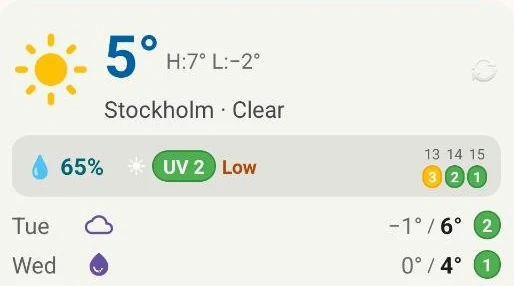
A single "max UV today" figure answers the wrong question. You rarely need to know the peak; you need to know whether the time you plan to be outside is risky. Weather Widget & UV Index shows the three upcoming 3-hour periods with the highest UV in each window, right on the widget. A glance tells you, for example, that UV stays low until noon and then climbs — so a morning run is fine and a lunchtime picnic needs shade.
For planning further ahead, the 7-day forecast includes the daily maximum UV for each day.
Pick the widget that fits your home screen
- UV widget — UV first, for people who spend a lot of time outdoors or have sensitive skin.
- Small widget — current temperature, conditions and UV in one compact tile.
- Medium widget — adds humidity and the upcoming UV windows, with a manual refresh button.
- Large widget — current conditions, UV windows and the coming days, also with manual refresh.
To add one, long-press an empty spot on the home screen, choose Widgets, find Weather Widget & UV Index and drag the size you want. Our widgets guide compares the layouts in detail.
Hot days: humidity and warning signs
On a hot day, UV is only part of the picture. Sweat cools you only when it evaporates, and high humidity slows that down, so 32 °C at 70% humidity strains the body far more than 32 °C in dry air. The widget shows temperature and humidity side by side; when both are high, treat the day as hotter than the thermometer says, do heavy work in the early morning when both heat and UV are lowest, and check your national weather service for heat advisories.
Heavy sweating, dizziness, headache, nausea, cramps and weakness can signal heat exhaustion: stop, move somewhere cool and drink water. Confusion, fainting, very high body temperature, or hot skin that has stopped sweating can mean heat stroke, which is a medical emergency — call emergency services.
Turning the number into an action
- Check the widget before leaving home and look at the window that covers your time outside.
- At 3 or above, combine protections: shade, clothing, a wide-brimmed hat, UV-blocking sunglasses and broad-spectrum sunscreen.
- At 8 or above, move long outdoor activities to the morning or late afternoon if you can.
- Remember that water, sand and snow reflect UV and increase exposure.
Children and outdoor workers build up the most exposure. For school trips, sports and outdoor jobs, the UV window matters more than the temperature.
Where the data comes from
Forecasts come from Open-Meteo for your current location or a point you select on the map. Recent current weather is cached for when the connection drops, but cached readings can be out of date — refresh before sun-sensitive plans. For heat or UV warnings, follow your national weather service.
Frequently asked questions
What UV index level needs sunscreen?
Health agencies including the WHO recommend sun protection from UV index 3 (moderate) upwards: shade, clothing, a hat, sunglasses and sunscreen used together.
Can the UV index be high on a cloudy or cool day?
Yes. UV depends on the sun's height, not the temperature, and thin or broken cloud lets much of it through. Check the UV value rather than judging by how warm it feels.
What do the three UV numbers on the widget mean?
They are the highest expected UV in each of the next three 3-hour periods, so you can see at a glance when UV will be low or high during the part of the day you plan to be outside.
Sources and further reading
How this article was created
This article was drafted with the help of artificial intelligence and edited against the app's published feature list. The independent developer is responsible for publication and accepts correction reports. Verify health, safety, legal, financial and official requirements with a primary source or qualified professional.
Questions and corrections: brightwaveapp@gmail.com. Legal and privacy information.